
Introduction: The Scrolling Brain & the Zoom Default
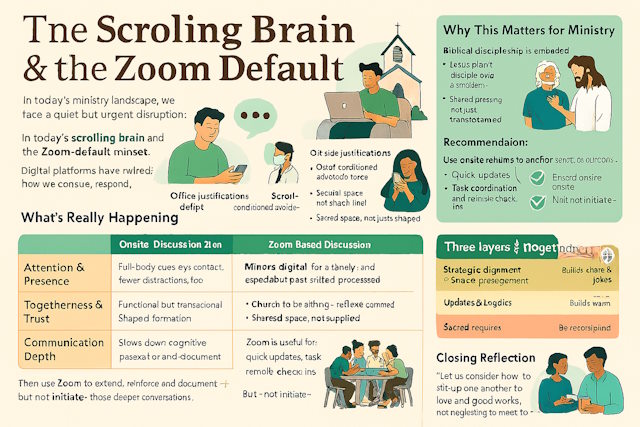
In today’s ministry landscape, we face a quiet but urgent disruption: the rise of the scrolling brain and the Zoom-default mindset. Digital platforms have rewired how we consume, respond, and relate. We scroll past truth, skim past nuance, and swipe away discomfort. Even in church settings, this rewiring shows up subtly—serious conversations are deferred to Zoom, while onsite gatherings become socially shallow.
This shift is not just logistical—it’s spiritual. When we outsource depth to screens and reserve face-to-face time for jokes and logistics, we risk:
- Discipling through pixels instead of presence
- Replacing embodied trust with transactional efficiency
- Forming teams that are connected but not transformed
Ministry is not just about communication—it’s about communion. And communion requires presence, pace, and courage.
What’s Really Happening
The use of “COVID,” “work from home,” and “efficiency” as justifications has created a default digital mode where serious conversations are outsourced to Zoom, while onsite gatherings drift toward social lightness. The result:
- Displacement of depth: Serious matters are postponed or deflected onsite, then squeezed into digital formats that lack emotional nuance.
- Fragmented togetherness: We’re physically present but relationally distant. Heart-level conversations happen in pixels, not in person.
- Scroll-conditioned avoidance: The “scrolling brain” prefers light, fast, and funny—so even in church, we default to chit-chat instead of courageous dialogue.
Cognitive & Emotional Effects
| Aspect | Onsite Discussion | Zoom-Based Discussion |
| Attention & Presence | Full-body cues, eye contact, fewer distractions. Encourages sustained focus and deeper listening. |
Fragmented attention, screen fatigue, multitasking temptations. Harder to read emotional nuance. |
| Togetherness & Trust | Shared space builds relational warmth and psychological safety. Informal moments (meals, hallway chats) deepen bonds. |
Functional but transactional. Harder to build trust or resolve tension without physical cues. |
| Communication Depth | Easier to clarify tone, intent, and context. Richer storytelling and spontaneous collaboration. |
Risk of misinterpretation. Conversations often feel compressed or overly structured. |
| Impact on “Scrolling Brain” | Slows down cognitive pace. Encourages reflection, dialogue, and embodied learning. |
Mirrors digital consumption habits. Can reinforce shallow processing and rapid toggling. |

Why This Matters for Ministry
Biblical discipleship is embodied. Jesus didn’t disciple via scroll or screen—He walked, ate, wept, and taught in person. Ministry conversations that shape identity, values, and calling require:
- Embodied trust, not just digital efficiency
- Shared presence, not just shared files
- Sacred space, not just scheduled slots
Church is not just a meeting—it’s a family. And families need more than updates and laughter. They need truth, correction, commissioning, and covenant conversations that happen face-to-face, heart-to-heart.
Ministry Implications
- Onsite is ideal for:
- Strategic alignment across ministries and committees
- Discipleship conversations that require emotional nuance
- Training seniors or youth in digital literacy
- Reframing communications as a ministry—not just a function
- Zoom is useful for:
- Quick updates, task coordination, and remote check-ins
- Supplementing—but not replacing—transformational dialogue
- Bridging geographic gaps when travel isn’t feasible

Recommendation
Use onsite rhythms to anchor serious discussions—especially those involving:
- Service DNA alignment
- Donor engagement strategy
- Digital disruption and spiritual formation
- Emotional intelligence and team correction
Then use Zoom to extend, reinforce, and document—but not initiate—those deeper conversations.
Framework: The Three Layers of Togetherness
This reproducible model helps teams name what’s happening—and gently shift toward deeper rhythms.
🧭 Layer 1: Surface
Chit-chat & Jokes
- Builds warmth and relational safety
- Important, but must not be the ceiling
🧭 Layer 2: Shared
Updates & Logistics
- Necessary for coordination
- Useful, but not transformational
🧭 Layer 3: Sacred
Truth, Correction, Calling
- Requires embodied trust
- Must be reclaimed onsite
- Zoom can support—but must not replace—this layer
Closing Reflection
“Let us consider how to stir up one another to love and good works, not neglecting to meet together…” — Hebrews 10:24–25
Let’s not outsource sacred conversations to screens. Let’s reclaim the table, the hallway, the prayer room, and the shared meal as places of transformation—not just presence.