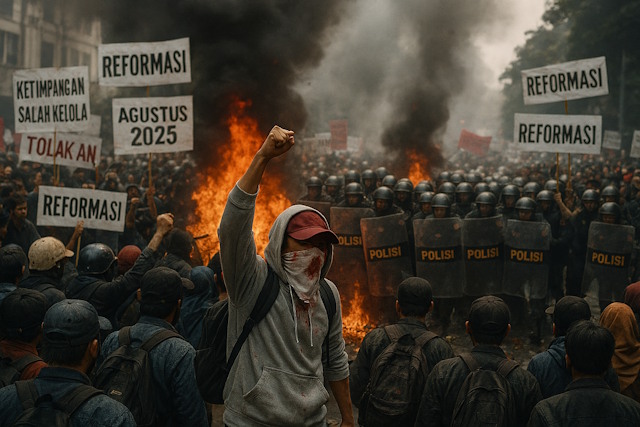
The widespread bloody wave of demonstrations across major cities in late August 2025 marked the peak of mounting public frustration.
What began as peaceful protests turned chaotic after the government’s efficiency policies were seen as starkly contrasting with the high allowances of parliament members.
The tragedies on August 25 and 28, when security forces responded repressively—leading to the death of an online motorcycle taxi driver, Affan Kurniawan, who was run over by a Brimob vehicle—ignited public outrage.
Riots broke out in several locations, revealing the widening gap between the people and the ruling elite.
Root of the Crisis: Mismanagement and Inequality
However, this situation did not arise suddenly. For months, the public had witnessed budget misallocation, economic misinformation, and arrogant behavior from self-serving officials. Parliament raised salaries and allowances, flaunted luxurious lifestyles, and failed to draft a budget that prioritized the people. Government officials and bureaucrats displayed power, became entangled in corruption due to the high cost of politics, and loved money and position more than public trust. The President, expected to lead reform, was instead seen as passive, allowing these deviations to persist.

For months, the public had witnessed:
- Budget misallocation that did not prioritize the people’s needs.
- Economic misinformation that confused the public.
- Parliament raising salaries and allowances while flaunting luxurious lifestyles.
- Government officials trapped in corruption due to the high cost of politics.
- The President seen as passive, allowing deviations to continue.
Tangible Impact on the Ground
As a result, the gap between the people and the elite widened. The people felt abandoned by a system that was supposed to protect and serve them. The consequences were real.
Ordinary citizens bore the burden of high food prices, expensive living costs, and confusing economic information. Millions of young people lost hope due to limited job opportunities. Small business owners, gig economy workers, and online entrepreneurs were pressured by heavy taxes and regulations. Teachers and workers received low wages without adequate protection. Even the police lost authority because the law was not enforced consistently. All this unrest eventually erupted in the streets.
Worsening Socio-Economic Conditions:
- Food prices and cost of living are soaring.
- Job opportunities are limited, especially for young people.
- Small businesses and gig economy workers are pressured by taxes and regulations.
- Teachers and workers receive low wages without adequate protection.
- Police lose authority because the law is not enforced consistently.
National Figures Speak Out: Reform or Collapse
All this unrest has finally erupted in the streets, becoming a symbol of resistance against structural injustice.
National figures such as Jokowi, Jusuf Kalla, Ahok, Rhenald Kasali, Cokro TV, Hendropriyono, and Mahfud MD warned that if this turmoil is not quickly calmed, economic life could come to a halt.
They expressed condolences to the families of the victims and demanded that authorities take firm action against those responsible.
Jusuf Kalla also urged the government and parliament to speak cautiously, so as not to further wound the hearts of the people.
- Condolences to the families of the victims.
- A warning that this turmoil could cripple the national economy.
- A call for authorities to act justly and for officials to speak with care.
Solution: Comprehensive Reform
But warnings alone are not enough. Concrete steps and political courage are needed. Comprehensive reform is the key. Laws and budget allocations must be fair and pro-people. The President must encourage problematic officials to take public responsibility, even resign if necessary. Parliament must evaluate and reform its programs to truly side with the people. The national budget must be directed toward creating jobs and business opportunities, because that is the state’s primary duty. Cutting officials’ salaries could be a symbolic and practical step, to remind them that public office is a trust, not a means of self-enrichment.
To quell the crisis and restore public trust, the government and parliament must:
- Reform laws and budget allocations to be truly pro-people.
- Encourage problematic officials to take public responsibility, even resign if necessary.
- Evaluate parliamentary programs to focus on job and business creation.
- Cut officials’ salaries as a symbolic and moral correction.
- Restore the essence of public office as a trust, not a means of self-enrichment.

Risk If Reform Fails
Indonesia does not need elites who love money, but leaders who dare to return politics to its essence: serving the people. If this solution is not implemented, demonstrations will continue to recur, public trust will erode, and the threat of economic paralysis warned by economists could truly become reality. Indonesia does not need elites who love money, but leaders who dare to return politics to its essence: serving the people.
Without real change:
- Demonstrations will continue to recur.
- Public trust in institutions will continue to erode.
- The threat of economic paralysis warned by economists could become reality.