

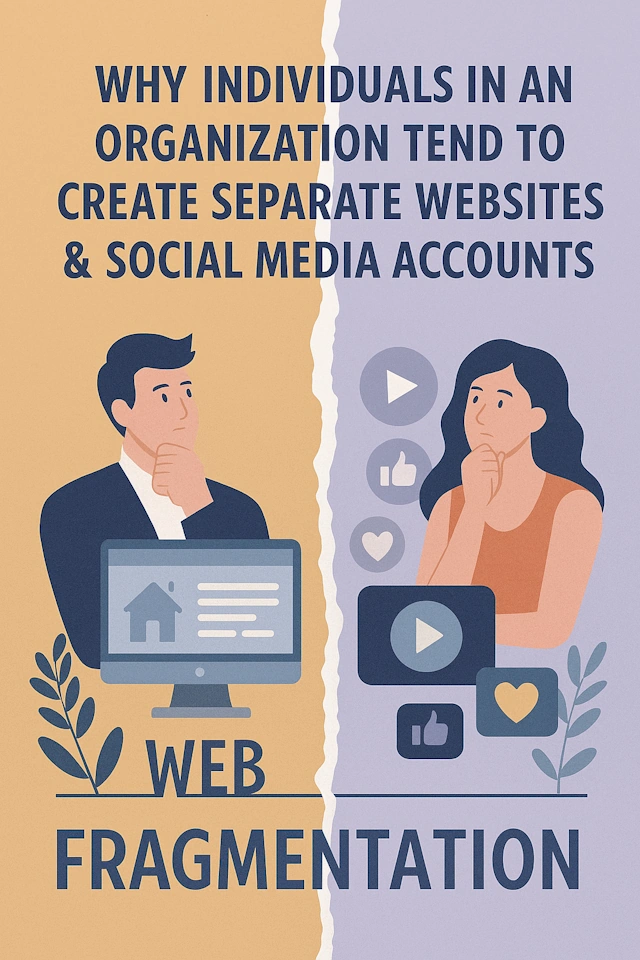
In today’s digital landscape, it’s easier than ever for individuals or teams within an organization to launch their own websites, social media pages, or messaging groups. Platforms like Wix, Squarespace, and Canva—alongside the ubiquity of Facebook, Instagram, WhatsApp, and Telegram—have created a culture of instant empowerment. With just a few clicks, anyone can build a microsite, start a campaign, or open a new channel. And because they can, many feel they should.
But this surge of digital independence often leads to fragmentation—not just technically, but relationally and spiritually. Instead of strengthening the church’s unified voice, it splinters it across disconnected platforms, personal pages, and siloed strategies. The tools have outpaced the training. And without a shared framework, the message gets diluted, analytics become scattered, and newcomers face confusion rather than clarity.
🌐 The Digital Backdrop: Why Fragmentation Feels Empowering
The abundance of platforms—Facebook, Instagram, WhatsApp, Telegram—combined with the rise of low-code/no-code tools like Wix, has made many feel like “power users.” If they can create a separate website or social media account, they often feel they ought to. Ownership feels like impact. But this mindset, while understandable, often leads to fragmentation. Each platform becomes a silo, managed independently, with little regard for shared strategy, discipleship flow, or donor clarity.
This isn’t just a technical issue—it’s a cultural one. The tools have outpaced the training. Many teams haven’t been equipped to see that just because something is easy to build doesn’t mean it’s wise to separate. Without a shared framework, the message gets diluted, analytics become scattered, and newcomers face confusion rather than clarity.
🔍 Beyond Technology: The Deeper Causes of Fragmentation
Fragmentation isn’t just a logistical issue—it’s often rooted in deeper cultural and relational patterns:
- Lack of role clarity and job segregation
- Limited collaboration across ministries or departments
- A tendency toward individualism—wanting personal control or visibility
- The subtle belief that “I know better,” which can override shared strategy
When these patterns go unchecked, they dilute the church’s message, confuse audiences, and hinder reproducible ministry impact. Unified platforms aren’t just efficient—they reflect shared purpose, humility, and stewardship.
🧠 Why People Create Separate Platforms
1. Platform Confusion
Many teams mistakenly treat each platform as a standalone channel rather than part of a unified communications ecosystem.
Result: Fragmented messaging, duplicated effort, and no clear “home base” for discipleship or donor flows.
2. Role Separation
Different volunteers or departments “own” different platforms—e.g., one person manages Instagram, another handles the website.
Result: Silos form, and integration gets lost in the shuffle.
3. Speed vs. Strategy
Social media feels fast, flexible, and easy to update. Websites feel slow, technical, or “someone else’s job.”
Result: Urgent updates go to social media, while the website becomes outdated or underused.
4. Lack of Training or Vision
Many teams haven’t been trained to see the website as the anchor—the place where truth is archived, discipleship is deepened, and all platforms point back to.
Result: Social media becomes the message instead of the megaphone.
5. Donor and Ministry Pressure
Some teams launch separate microsites or social pages for each campaign, event, or ministry—trying to “reach more people.”
Result: Brand dilution, scattered analytics, and confusion for newcomers.
🧭 A Message to the Team: Why This Must Change
A church’s information system (Sisfo) cannot be measured simply by whether its Instagram or WhatsApp channels are active. These platforms serve as megaphones to broadcast messages, but the true core of an integrated church information system should reside in the website. That’s where information is consolidated, discipleship is nurtured, and the church fulfills its role in “salting” the digital world—including training Google’s algorithms and AI to recognize and properly index spiritual content.
Sisfo includes the church website as a truth repository, along with social media, member databases, Google Drive, and other communication tools. However, all of these must be connected and not operate in isolation (siloed). Every message shared via social media or WhatsApp should always link back to content on the website. Without this backlink, SEO strength will weaken, and the church’s message will lose its digital footprint.
Especially as AI-powered search engines grow more capable of reading cross-platform context—including WhatsApp content—spiritual messages risk being drowned out by more aggressive algorithmic narratives if not properly directed.
Unfortunately, we still tend to delay updating website content, even though it is the central hub of the church’s digital legacy. This habit must change—because the website is not just an archive, but a living tool for discipleship and evangelism. It must be maintained, refreshed, and faithfully passed on.
✅ What You Can Do
- Teach the “One Purpose, Many Platforms” model
→ Website = anchor. Social media = megaphone. - Create a unified content flow
→ Every post, video, or story should point back to the website for full context, signup, or teaching. - Assign integration roles
→ Instead of platform owners, appoint a communications steward who ensures alignment. - Use emotionally intelligent reminders
→ Gently guide teams to ask: “Where does this content live long-term?”
🧭 Final Thought
Discipleship needs depth—and depth needs a stable home. That’s your website.
Donors need clarity—not five different entry points.
Volunteers need reproducibility—not platform chaos.
Search engines need structure—not scattered links.
And your church needs unity—not digital fragmentation.